The Two-Way Street
From inner world to real world

(Would you rather listen? Press “play” above.)
I’m halfway through Joseph Campbell’s journals from his first trip to India in 1954, a collection printed after his death as Baksheesh & Brahman. My own life and outlook have been deeply influenced by the great mythologist, whose PBS series The Power of Myth, consisting of interviews between him and the journalist Bill Moyers, served as a captivating introduction to his work when I was in high school.
Many of Campbell’s reflections, meant for his own personal use, reveal an unfolding disillusionment with India. Its spirituality, its texts (notably the Upanishads, the Bhagavad Gita), its remarkable mythology which also contains the philosophical jewels of the system, were a profound source of inspiration in Campbell’s work and life, but he realized they were born of a culture much different than the one in which he found himself. Desperate poverty, the avarice of the rich, a venal clerical class, a Janus-faced nationalism – all of these, the scholar felt, were unworthy of the teachings he had immersed himself in for years, and this conflict of past ideals with current degraded realities shook him awake.
We in the west have a fetishization of eastern spiritualities, something I saw firsthand as a yoga teacher, and we’re often told, especially in regard to western material comforts compared to that of the daily resources of those in the east, that the poor people of India (China, Indonesia, etc.) might be broke, but gosh darn it, they’re happy, a position only espoused by those living high on the hog.
Co-teaching a 500-hr yoga teacher certification program, I recall one young woman telling us of her latest, earnest practice. Walking with her down the street after class, along with a couple of other friends and my husband, she told us how she’d limited her food in order to feel the suffering of the poor first-hand. “I really want to know how they feel.”
“You wanna know how they feel? Hungry.” (The retort of my outraged husband.)
Campbell, visiting the home of a Hindu brahmin family, was treated to some sage ideas from the patriarch:
“…the philosophy of the West is materialistic, that of India spiritual…the condition (the poverty and squalor) of India is a consequence of its philosophy…therefore the philosophy of India is inferior to the philosophy of the West.”
If a spirituality can not better the basic needs of its adherents, it has no use. I am, by no means, saying that India’s spiritual inheritance is empty; I happen to think it’s one of the most refined systems the world has ever known; however, without an applicability to improving the lives of the desperate, who cares about mantras? It’s a clever trick of the powerful to inculcate the masses on a structure of beliefs which rewards suffering instead of relieves it.
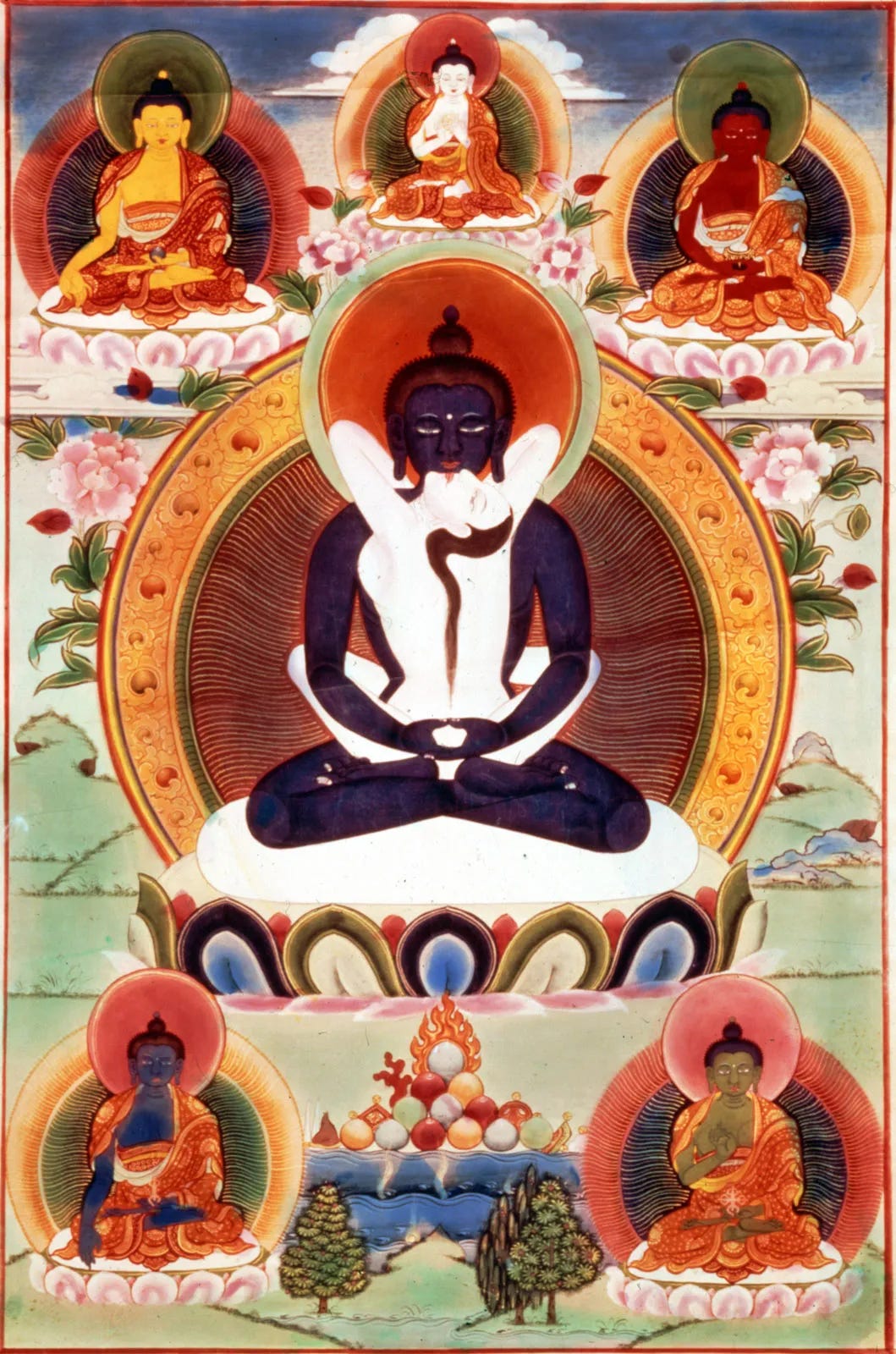
I’m reminded of the Tibetan Buddhist image of the Yab Yum, in which an enlightened Buddha sits with his Shakti, a female figure representative of pure energy, on his lap, but she faces him, the pair in divine union. The spiritual seeker, and then enlightened one, turns their energy completely inward, away from the distractions of the world, and is thereby able to come into a state of one-ness with that energy. But that’s never meant to be a frozen state, the end of the hero’s journey; we must be able to go back and forth. We turn the energy away from the world, towards ourselves, in order again to drink from the fountain of peace and clarity within us, only to turn that energy outwards once more, so that our actions are suffused with the wisdom gained thereby.
More from Campbell:
“India has turned its poverty into a kind of sadhana [a spiritual practice]; Gandhi stressed this. There is consequently a quality of spirituality about this Indian poverty, which is impressive. Other sadhanas however, were possible in the past: the kingly sadhana of Arjuna, for example.”
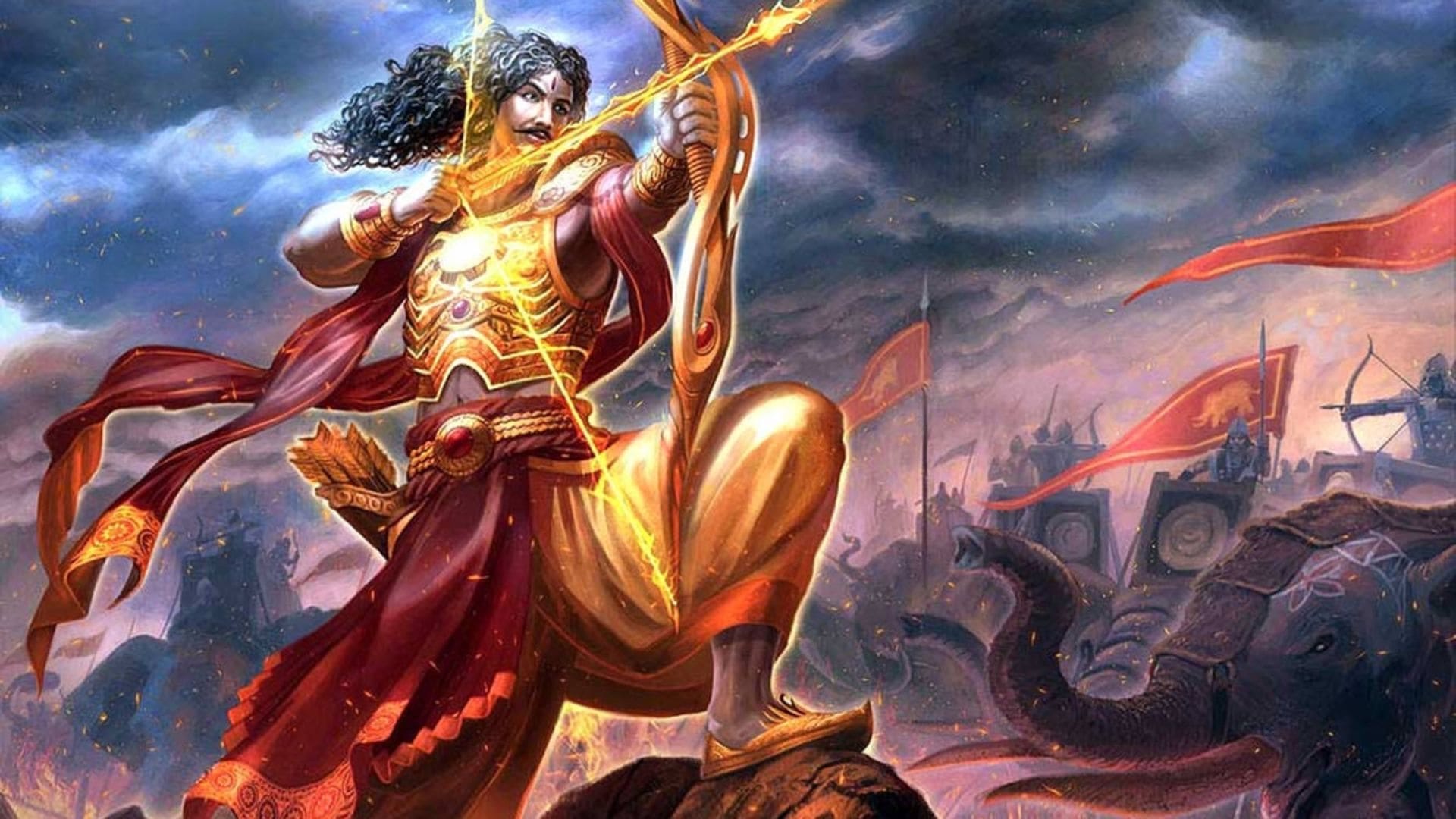
Arjuna is one of India’s prime heroes and the one who first hears the philosophy poured forth from Krishna’s mouth in the Bhagavad Gita. Arjuna is a warrior. He kills his adversary (and no, that’s not just a bloodless metaphor). He’s a hunter. He’s a lover and a fighter. And he’s incredibly skilled at the spiritual techniques which allow him to do all of the above with honor.
This is very different from a sadhana of poverty, where material misery is elevated to sanctity, hallowed as the reward of spiritual greatness in lieu of a reliable lunch. (Christianity does this beautifully – it’s easier for a camel to pass through the eye of a needle than a rich man to enter the kingdom of heaven.)
There’s a story I particularly love of Veda Vyasa, a great sage, who urged his spiritually advanced son, Suka Deva, to take a wife. The young man isn’t buying it, saying it will only cause him to backslide on his practices, on his march to moksha, enlightenment; after all, no householder can attain ultimate freedom.
So Veda Vyasa packs him off to King Janaka, a jivanmukta, a soul enlightened while living, to learn the alternate facts of life. The youth argues with Janaka, who remains calm, charmed by the younger man’s internal struggle, until finally, unconvinced the king isn’t attached to his wealth, his wives, and his power, Suka Deva stalks toward the door of the throne room, determined to head back to his cave in the jungle.
“You came to me, because your heart is full of doubt,” Janaka calls after him, “and yet I am seeking no one and nothing. I have no doubts about the wisdom passed to me from my guru, your very father. You are bound because you think you are bound. I am free because I know there is no bondage.”
That does it. Suka Deva hears the voice of truth and does, indeed, end up entering the householder life, a life King Janaka describes as the “best of ashrams.”
One of Campbell’s continued analyses in his journals is about the path of bhakti, the devotional tradition of India’s spiritual offerings, an ecstatic path of love for one’s chosen deity, and he says that ultimately it creates an infantile relationship to the divinity (which is only a projection of the votary’s ego onto the ineffable). In bhakti, like a child to a parent are we to approach the god/dess, which leaves us in a childish relation to the world.
I remember hearing several talks by a Hare Krishna teacher, Radhanath Swami, who laid out the principles of bhakti (inexplicably only applied to Krishna, but fanatics are fanatics), and one of its main ideas is that the bhakta, the worshipper, doesn’t seek out enlightenment, only to be forever in this devotion to the deity. There’s a frozen quality to the goal. Let me stay on the love train forever. Let me never disembark. Let my Shakti forever face me.
But that’s not how life (or, I would argue, “god”) works. At some point we’re asked to grow up, to move on, to experience all life throws at us, not as babes in the woods, but as adults walking alongside the divinity which, ultimately, is nothing more than the most profound part of ourselves.