
My Own Odyssey
Or, why I won't be seeing the movie

(Rather listen? Press ‘play’ above.)
A. In NYC, a ticket is $30. I don’t think so.
B. The casting. I’m not so convinced about Matt Damon as the wily Odysseus, though I think he’s got a shot. I find Nyong’o as Helen an intriguing choice, as she’s certainly beautiful (playing the face that launched a thousand ships is always a risky endeavor) and a good actress. Perhaps even more fascinating is the ire she’s ignited; in many ways, she’s become a lightning rod for a partisanship that feels very much in line with the Trojan legend – a woman who inspires just as much hatred as she does devotion. I think it’s rather cheeky to have Elliot Page (originally of Juno fame) play Sinon, the treacherous Greek who convinces the hapless Trojans to drag the fateful horse into the city (an episode from Roman poet Virgil’s Aeneid and not Greek ‘Homer’s’ Odyssey). Sinon is not what he seems; neither is Page who is trans. An inside joke? A bit of gender-blind casting (although said-blindness is not possible)? A sop to the Cerberus of current cultural McCarthyism?
C. No, the real reason I won’t be seeing The Odyssey is because it lives too well in my mind. No one else’s vision can achieve the same potency as the story in my imagination, because that’s how stories, storytelling, and especially archetypal/mythic stories work: they hit us where they’re supposed to, each of us taking away something different, each of us remembering a particular event in the tale that seemed oversized.
Back when I was a yoga teacher, obsessed as I became about the mythology, philosophy, and theology of India, I ended up being asked by various studios to give lectures, workshops, and trainings about those myths. I began by telling a story – often how Ganesha gets his elephant head as his image was plastered all over yoga studios without any understanding of how he got to be who he is. I’d tell the tale and then go around the room and ask each person what moment struck them. The answers swung wide, each person recalling something different, because where the story lands is reflective of our consciousness in the moment we hear it. That can change from one day to the next, though more likely it takes longer for a different detail to emerge, but this is the mechanism whereby these tales thrive for thousands of years.
A film, on the other hand, is one person’s vision of what’s important: the edits, the camera focus, the closeups, all of these are the director’s version of the story. This is not a bad thing, it’s just limited, and I don’t like the limit. Stage is different; our visuals are not constrained by the camera, although the increased reliance on projections, an intellectually lazy choice, has changed that. I saw a production of Othello a few weeks ago produced by the Classical Theater of Harlem, and although the director obviously had a point of view, the fact that my eye could wander, could “cut,” if you will, to watch Iago as Desdemona pressed her husband for leniency with Cassio, meant I was now an active participant in the creation of the story; in a movie, we are passive receptors.
I’ve lived with these Greco-Roman myths and epics since boyhood, so I’m fascinated by my own development with them, what they continue to mean, how they change, what they awaken within me, what I’ve said farewell to in my own consciousness as my relationship with the characters has aged. It wasn’t until a re-read of the Odyssey almost ten years ago that I was spellbound by Helen’s appearance, by the nepenthe she pours into the cups to banish the pain of the past, but also perhaps to lessen any resentments against her – what was her agency in the famed abduction, after all? did she have any? was she only a plaything of the gods? She is a wily one, another character whose shrewd intelligence makes her master of the scene (much like the other women directly involved in the epic, Penelope, and indirectly, Helen’s half-sister Clytemnestra).
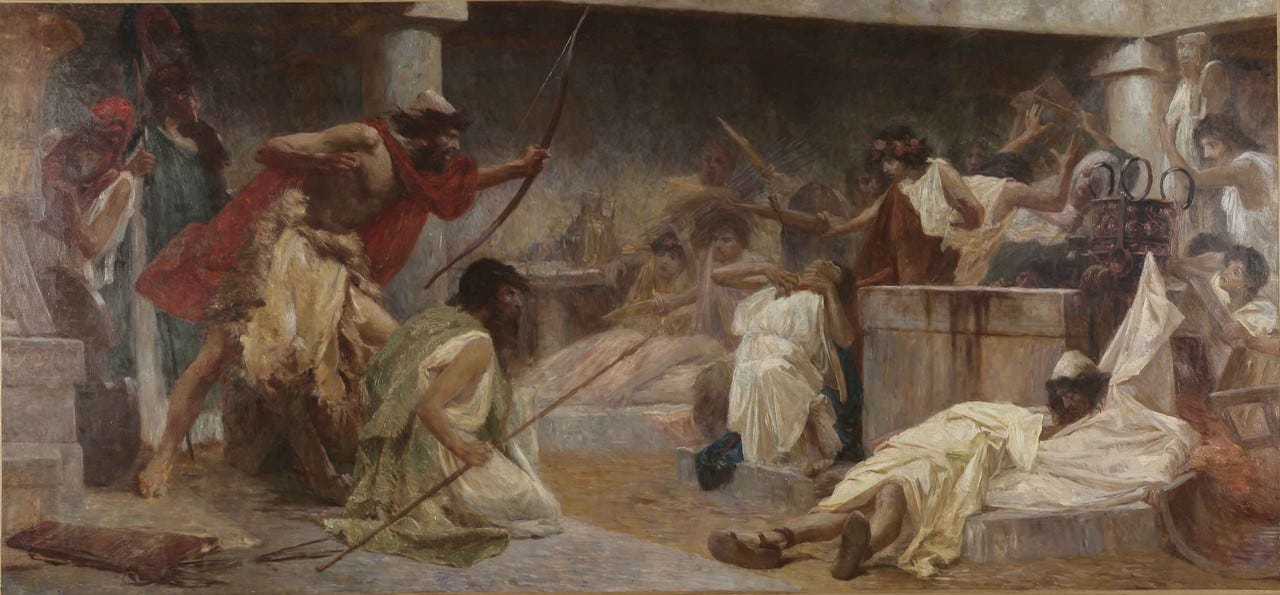
My childhood memories of the Odyssey focus on Athena’s brilliance and craft, Penelope’s unweaving, and Odysseus’ famed encounters with Polyphemus and Scylla and Charybdis. But in that re-read at aged 40, the vengeance our hero takes upon the suitors thrilled me. Somehow, I never remembered it as a youth, but as an adult, one who would dive into the ruin of an abusive childhood in five years’ time, the chance to right outrageous wrongs sang loudly in verse.
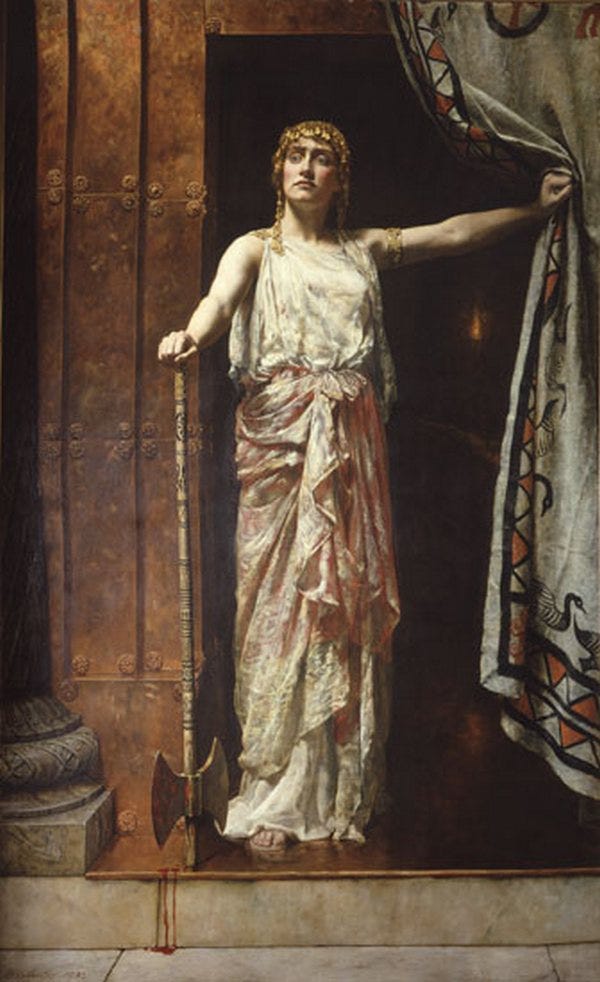
Also around that time, I spoke to a forensic traumatologist, someone who worked with the U.N. on cases of trafficking; she also ran her own psychological practice to help victims of war. She told me two things that reminded me of Odysseus’ revenge (or Clytemnestra’s rightful justice):
First, naturalists have observed that lionesses on the savannah kill and eat a baby elephant. The bereaved matriarch rounds up her sisters, and the pachyderms charge into the lion pride, trampling the lion cubs. No eating. Just destruction.
Second, studies in this traumatologist’s field suggest that people who get revenge on their persecutors suffer PTSD at far lower rates than those who are reft of a chance at vendetta or who turn the other cheek because that’s the “good” thing to do.
Then, I thought of depth psychologist James Hillman who, in his book The Dream and the Underworld, reminds us that the etymological origin of the Underworld River Styx relates to a Greek word meaning “hatred.” The gods swear their unbreakable oaths on this icy waterway, perhaps the only thing they consider sacrosanct.
Hatred. Anger. Revenge. They’re all a part of the universe, call it moral or not. In these contexts, Odysseus’ revenge (about which I’ve seen too much hand-wringing and umbrage regarding patriarchy, toxic masculinity, etc. – puh-leeze – again, see Clytemnestra, see Medea) is righteous and so perhaps is ours, however we get it. At the very least, this episode in the Odyssey stirs dark and fertile soil within our own psychology, a trip into our own Underworld, a journey both dreadful and packed with treasure.
A movie can’t give me time, can’t give me maturation, can’t allow me to roll around with linguistic turns that reveal to me things about myself, the world, and my place in it. The rich expressions of those bards who’ve learned, as Jonson said of Shakespeare, that a poet’s made as well as born, are what most captivate me.
So I think I’ll crack open another translation of the Odyssey (last year I read T.E. Lawrence’s prose version) and see what hits me on the cusp of 50.
And I’ll save thirty bucks!
I would love to hear your take on the changes they made and the end take they took, granted in Hollywood epic fashion so more people may watch…that heroes of the heroic age took something sacred from the world with their egos and their violence that may still be reclaimed by setting those egos aside and choosing something better now…We are The Sea People. Do better…if you ever choose to see the film but respect your wanting not to.🫶
I never thought about how we’ve increased the influence of the creator - from book to play to film.. interesting..I agree with everything you’ve said about myth and how it’s only real as it comes alive in us.
And yet I have to say, as someone whose visual imagination is definitely not a strength, I enjoy the colors, the sights on the screen - as if I were there. I suppose it also allows me a form of escapism that can be so needed in these times. I’m sure others can do this in their imaginations but I’m still working on mine.
I loved reading your review and now may have to see the movies confession- okay seeing Lupita has something to do with this.